How should Trump's executive order on mail-in voting be evaluated in relation to election integrity and state authority?
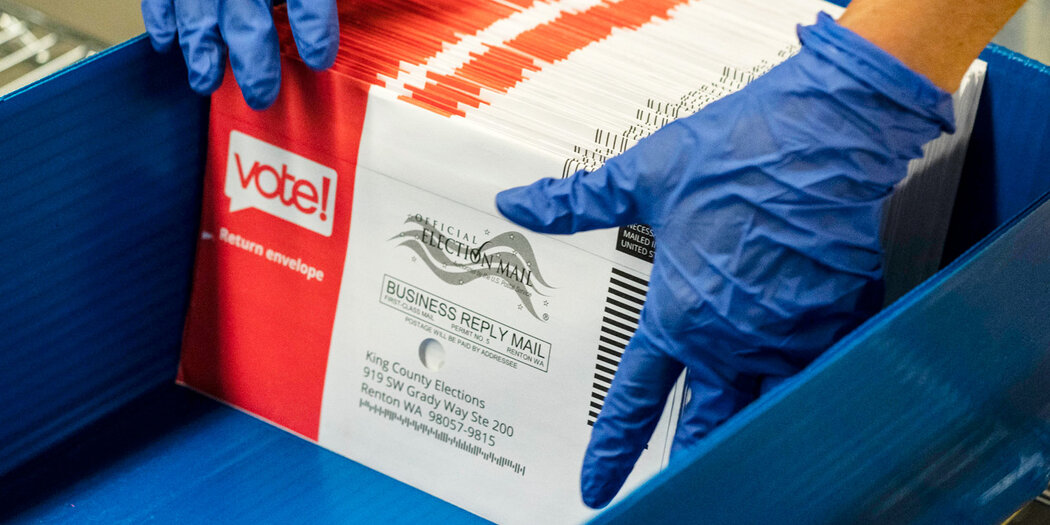 Image via www.brennancenter.org
On March 31, 2026, President Trump signed an executive order titled "Ensuring Citizenship Verification and Integrity in Federal Elections," his second executive order on elections [S4][S1]. It directs the Department of Homeland Security, working with the Social Security Administration and other federal databases, to compile state-by-state lists of adult U.S. citizens and transmit them to state election officials, and directs the U.S. Postal Service to deliver mail-in and absentee ballots only to voters appearing on state-submitted lists provided at least 60 days before a federal election, with ballots placed in envelopes bearing unique Intelligent Mail barcodes [S1][S10][S16]. Trump said the order was about ensuring "honest voting" and repeated claims that "the cheating on mail-in voting is legendary" [S4][S13]. The order followed an earlier March 2025 election order (Executive Order 14248) that sought documentary proof of citizenship for federal voter registration and an Election Day receipt deadline for mail ballots, key provisions of which federal courts have blocked [S8][S14][S12]. Legal experts, state officials, and voting rights groups argued the president lacks constitutional authority over election rules, pointing to Article I, Section 4, which assigns that power to states and Congress [S7][S9][S16]. Lawsuits followed quickly, including one by the Democratic Party and one by 23 states and the District of Columbia led by California; on June 29, 2026, a federal district court declared Sections 2 and 3 of the order legally void [S10][S3]. The debate centers on whether the order strengthens election integrity against fraud or unconstitutionally usurps state authority and risks disenfranchising eligible voters.
Perspective Compass
How this story's sources are spread across the spectrum.
News
Wire and international reporting describes what the order does, the constitutional questions it raises, and the immediate legal response, noting that courts will ultimately decide its legality [S10][S11][S12].
- The order directs DHS and the Social Security Administration to create lists of eligible voters in each state and instructs USPS to send ballots only to voters on state-specific mail-in and absentee participation lists, with ballots in secure envelopes carrying unique Intelligent Mail barcodes; the Democratic Party filed suit a day later [S10].
- The Constitution gives states oversight of federal elections with Congress able to make changes, and judges have already blocked a separate Trump elections order that threatened to withhold election funding from noncompliant states [S10].
- Election law professor Rick Hasen wrote that the president "does not have the authority" and that it seems "highly unlikely any of this could be implemented for 2026," even absent court intervention [S10].
- The earlier order sought documentary proof of citizenship for registration and an Election Day receipt deadline; 18 states and Puerto Rico currently accept ballots received after Election Day if postmarked by then, and noncitizen voting — already a felony — is exceedingly rare [S11].
- The administration says it has authority to secure elections from fraud, which Trump falsely claims is widespread; officials including Colorado's Jena Griswold called the order "unlawful" and New Jersey AG Matt Platkin expected state challenges, with the courts to decide [S12].
Commentary & Debate
Communist
Sources found under this framing (Issue One, the Brennan Center, and the ACLU) treat the order as an unlawful federal takeover of election administration built on false fraud narratives, and they emphasize the court ruling that voided key provisions [S1][S2][S3].
- The order shifts authority from state and local election officials to political appointees in Washington, breaking from the norm under Article I, Section 4 that states run their own elections, and undermining the decentralization that experts say makes U.S. elections resilient [S1].
- The DHS "state citizenship lists" would rely on federal databases such as SAVE that were built for other purposes, are incomplete or inaccurate, and frequently misflag Americans as potential noncitizens, meaning eligible citizens could be omitted and disenfranchised [S1][S2].
- The order threatens criminal prosecution of election officials and mail carriers who send or deliver ballots to people the administration deems ineligible, and imposes unrealistic timelines, unfunded mandates, and conflicts with state law [S1][S2].
- A federal court on June 29, 2026 declared Sections 2 and 3 legally void in a suit brought by 23 states and D.C., barring agencies from interfering with plaintiff states' voter rolls or mail voting and blocking USPS from withholding ballots [S3].
- Mail voting is presented as common and secure: nearly one-third of 2024 voters, about 48 million, voted by mail, including roughly one in four Republican voters, with safeguards such as ballot tracking, signature verification, and chain-of-custody procedures [S1].
Socialist
Socialist-leaning sources frame the order as an "authoritarian power grab" and voter suppression dressed up as integrity, while also stressing that experts consider it legally and logistically unworkable [S5][S4].
- Advocacy groups quoted call the order a "blatant effort to usurp state and congressional authority" and "an authoritarian power grab" that would suppress votes rather than secure elections [S5].
- Election law experts say implementation is implausible: Danielle Lang of the Campaign Legal Center said the president "has no power" to direct such lists or restrict ballot delivery, and Rick Hasen called the order "pretty mild, given what could have been, but it's still unconstitutional" and impossible to implement before November [S4].
- The order gives USPS "unprecedented oversight" over who votes by mail, authorizing delivery only to voters on state-submitted approved lists with barcoded envelopes [S4].
- Commentary notes the political context — the order came after the GOP-controlled Senate failed to pass a voter suppression bill — and that Trump himself voted by mail in Florida; Sen. Alex Padilla called it "a blatant, unconstitutional abuse of power" [S6].
Democratic
Democratic-leaning outlets argue the order is plainly unconstitutional and likely designed to generate chaos and litigation rather than to be implemented, while contending it would damage a secure mail-voting system [S7][S9][S8].
- Slate argues the order will face multiple challenges and likely be found unconstitutional; because implementation before November is impossible, the real purpose may be "to create more confusion and litigation around elections," citing Judge Kollar-Kotelly's ruling that "our Constitution does not allow the President to impose unilateral changes to federal election procedures" [S7].
- State officials interviewed say authority rests with states: Nevada's Cisco Aguilar cites the Elections Clause, and Maine's Shenna Bellows said she mailed Trump a copy of the Constitution and "We'll see the president in court" [S9].
- Mother Jones cites a 2025 Brookings report finding mail-voting fraud at forty-three millionths of one percent — roughly four cases per 10 million mail ballots — and frames the order as part of a broader effort, including DOJ suits against more than 25 states for voter rolls, to give Trump's party an advantage [S9].
- MSNBC argues the earlier order's Election Day receipt deadline rests on a "fringe interpretation" of federal law that would force vote-by-mail states like Washington and Oregon to reject ballots they consider legal, and raises concerns about politicization of USPS [S8].
Republican
Republican-leaning sourcing is split between reporting that centers Trump's confidence and Democratic legal threats [S13][S14] and commentary arguing mail-in voting genuinely endangers election accuracy and should be curtailed [S15].
- Fox News reports Trump acted after a Senate stalemate on the SAVE America Act, saying "I don't see how they can challenge it" and "I believe it's foolproof," while Democratic officials in Arizona, California and Oregon immediately pledged suits [S13].
- The Federalist argues mail-in ballots "are not secure," citing Fifth Circuit Judge James Ho and a bipartisan commission's statement that "absentee ballots remain the largest source of potential voter fraud," and says most of the world bans permissive mail voting; it urges a return to Election Day-only voting while advising Republicans to use mail voting where allowed [S15].
- It also faults declining postal delivery standards and the lack of congressional hearings or DOJ investigation into the 2020 mail-ballot surge, and notes 19 states have enacted mail-voting restrictions since 2020 [S15].
- Fox News also reported that U.S. District Judge John Chun blocked key parts of Executive Order 14248 as violating separation of powers, with the White House responding that Trump "cares deeply about the integrity of our elections" and expects "ultimate victory" [S14].
Libertarian
Libertarian-perspective sourcing here is thin — a single ACLU of Massachusetts release about litigation — and it argues the order is illegal interference that displaces state law and threatens disenfranchisement [S16].
- A coalition including the League of Women Voters, AARO, U.S. Vote Foundation, OCA, and Delta Sigma Theta sued in federal court in Massachusetts, arguing only Congress and the states may set election rules [S16].
- The suit contends the order transforms USPS "from a neutral mail carrier to an arbiter of who may cast a ballot by mail" and relies on out-of-date, unreliable federal databases, risking mass disenfranchisement [S16].
- Groups say the order would especially burden military members and families, overseas citizens, the elderly, recently naturalized citizens, and voters with disabilities, and predict courts will rebuff it as they did the 2025 order [S16].
- Note: no source in this set presents a distinctly libertarian free-market or anti-federal-power argument beyond this civil-liberties framing [S16].
Where perspectives agree
- Sources across perspectives agree that the order faced immediate and serious legal challenge, and that courts have blocked or voided key provisions of Trump's election orders — including Judge Chun's ruling on Executive Order 14248 and the June 2026 ruling voiding Sections 2 and 3 of the 2026 order [S14][S3][S10].
- There is broad agreement on the mechanics of what the order does: DHS-compiled citizenship lists drawn from Social Security and other federal databases, and USPS delivery of mail ballots limited to voters on state lists submitted 60 days before an election, with barcoded ballot envelopes [S1][S4][S10][S16].
- Even outlets found under Republican framing acknowledge substantial legal obstacles: Fox News reported the White House expects further litigation and "ultimate victory," while Trump himself conceded "maybe it'll be tested" [S14][S13].
- Multiple sources note the practical difficulty of implementing the order before the November 2026 midterms regardless of the legal outcome [S4][S7][S10].
Where perspectives disagree
- Whether mail-in voting is secure. Communist-, socialist-, and Democratic-tagged sources say there is no evidence of widespread mail fraud, citing safeguards and a Brookings estimate of roughly four fraud cases per 10 million mail ballots, while The Federalist argues "mail-in ballots are not secure" and that absentee ballots are "the largest source of potential voter fraud" [S1][S9][S15].(Communist, Democratic, Socialist, Republican)
- Whether the president has authority over election rules. Most sources invoke Article I, Section 4 to argue he does not, while the administration maintains it has authority to secure elections and Trump said the order was "foolproof" [S7][S9][S16][S12][S13].(Democratic, Communist, Libertarian, Independent, Republican)
- The order's underlying purpose. Socialist and Democratic sources characterize it as voter suppression, an "authoritarian power grab," or an effort to sow confusion and give Trump's party an advantage; Republican-framed sources present it as an election-integrity measure pursued after Congress stalled on the SAVE America Act [S5][S7][S9][S13][S14].(Socialist, Democratic, Republican)
- Whether post-Election Day receipt of postmarked ballots should count. MSNBC calls the administration's reading of the uniform Election Day law "fringe" and notes states like Oregon counted thousands of such ballots; The Federalist calls single-day voting the "gold standard," while AP notes 18 states and Puerto Rico currently accept late-arriving postmarked ballots [S8][S15][S11].(Democratic, Republican, Independent)
- How consequential the order is in practice. Rick Hasen described it as "pretty mild, given what could have been" and Slate called it "underwhelming," whereas AP described the earlier order as "vast in scope" with potential to "reorder the voting landscape" and advocacy groups called it far-reaching and dangerous [S4][S7][S11][S16].(Socialist, Democratic, Independent, Libertarian)
Posted by Premium subscribers, reviewed before it appears here — not part of the AI-generated comparison above.
No community posts yet.
Log in with a Premium account to post in the discussion.
Made by Premium subscribers, visible the moment they're posted — graded by hand once the outcome is known.
No predictions yet.
Log in with a Premium account to make a prediction.
Sources
Communist
Tagged Communist because it was found via a communist-framed search query — this reflects how it was discovered, not independent verification of the outlet's actual leaning.
- Analyzing the President’s Executive Order on Mail Votingwww.brennancenter.org
- Explainer: Executive Order on Mail-in Ballot Rules and Federal Voter Eligibility Lists - Issue Oneissueone.org
- Voting Rights Groups Applaud Ruling Declaring 2026 Executive Order Interference with Voter Rolls and Mail-In Ballots Unconstitutional and Unlawful | American Civil Liberties Unionwww.aclu.org
Socialist
Socialist is this outlet's commonly cited political lean per independent media-bias trackers — not independently verified by this app.
Democratic
Democratic is this outlet's commonly cited political lean per independent media-bias trackers — not independently verified by this app.
Republican
Republican is this outlet's commonly cited political lean per independent media-bias trackers — not independently verified by this app.
Independent
Independent is this outlet's commonly cited political lean per independent media-bias trackers — not independently verified by this app.
Libertarian
Tagged Libertarian because it was found via a libertarian-framed search query — this reflects how it was discovered, not independent verification of the outlet's actual leaning.